

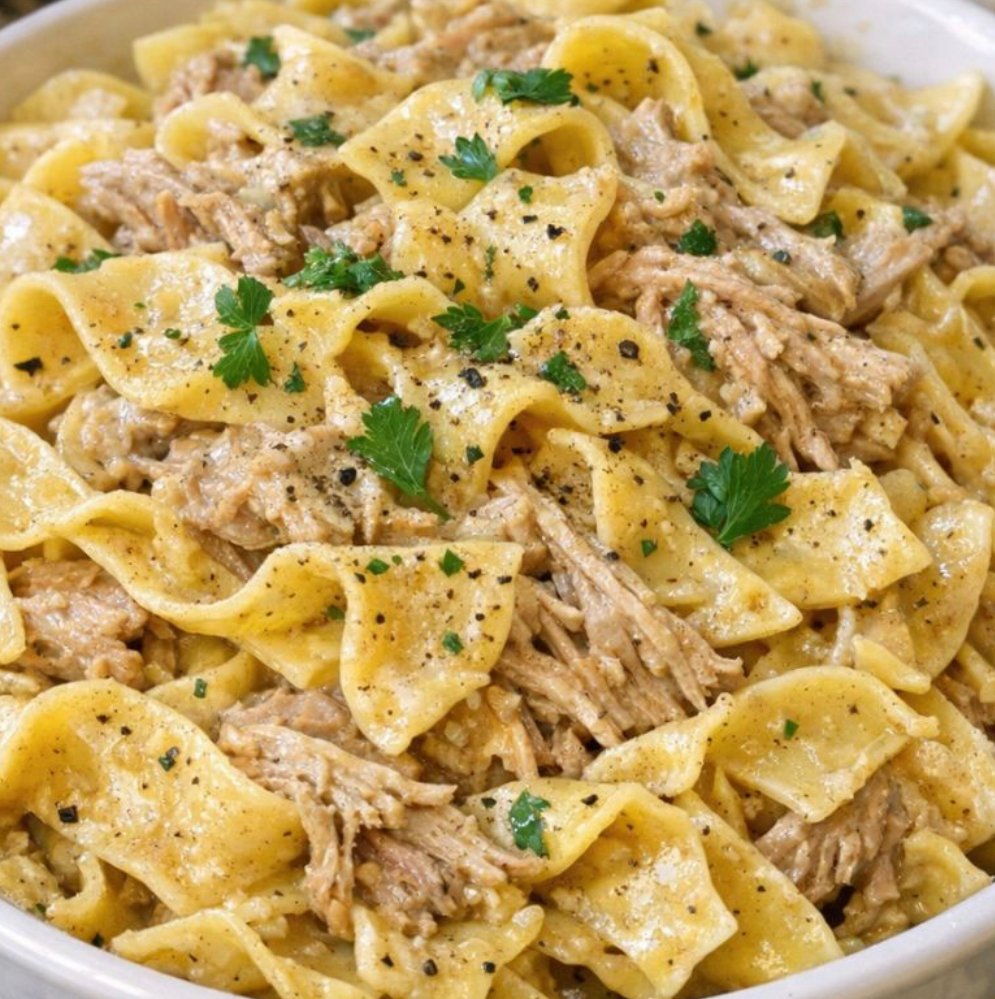
The Tangy, Creamy, Fall-Apart Pork Dish You Did Not Know You Needed (With Zero Canned Soup)
Let me introduce you to a flavor combination that sounds strange but works like magic.
Mustard. Brown sugar. Pork. Noodles.
No, really. Stay with me here.
Yellow mustard – that bright, tangy, ballpark-style condiment – transforms into something completely different when it meets brown sugar and slow-cooked pork shoulder. The sharp mustard mellows into a silky, tangy richness. The brown sugar adds depth and caramel sweetness. The pork shoulder breaks down into tender, shreddable perfection. And wide egg noodles soak up every drop of that glorious sauce.
This is Amish cooking at its finest. Simple ingredients. Big flavors. Zero fuss. No canned soup. No mysterious seasonings. Just honest food that fills bellies and warms souls.
The first time I made this, I was skeptical. Mustard as a sauce base? On pork? With noodles?
Then I took a bite. And another. And another.
Now I make it every month.
Five ingredients. One slow cooker. A dish that will surprise you in the best possible way.
Let me show you why these Slow Cooker Amish Mustard Pork Noodles deserve a spot in your dinner rotation.
Why This Recipe Is a Hidden Gem
You have made slow cooker pork before. You have made mustard-based sauces before. You have never made anything like this.
Yellow mustard transforms completely – Raw yellow mustard is sharp, tangy, and almost aggressive. But after 8 to 9 hours in a slow cooker with brown sugar and pork? It becomes silky, mellow, and deeply savory. The vinegar mellows. The mustard seeds soften. The turmeric adds a beautiful golden color. You will not believe it came from a squeeze bottle.
No canned soup required – Most creamy slow cooker recipes rely on condensed cream soups. Not this one. The sauce comes from mustard, brown sugar, and the natural juices of the pork. That is it. Clean ingredients. No mystery additives.
Pork shoulder is budget-friendly magic – Pork shoulder (also called pork butt or Boston butt) is one of the cheapest cuts of meat. It is also one of the most flavorful. The marbling and connective tissue break down during long, slow cooking into tender, juicy, shreddable perfection. You get luxury texture at ground beef prices.
The noodles cook right in the slow cooker – No boiling water. No extra pot to wash. The dry egg noodles go straight into the slow cooker at the end, where they absorb the mustard-pork sauce and become tender and flavorful. One pot from start to finish.
Sweet, tangy, savory, creamy – all in one bite– This dish hits every note. Sweetness from the brown sugar. Tanginess from the mustard. Savory depth from the pork. Creaminess from the sauce (which comes from the rendered fat and mustard emulsifying together). It is balanced, complex, and utterly addictive.
Amish simplicity at its best – The Amish know something that modern recipes often forget. You do not need twenty ingredients to make something unforgettable. You just need the right ones, prepared with care and time.
Ingredients
Five simple ingredients. Each one earns its place.
3 to 3½ pound boneless pork shoulder or pork butt roast – This is the star. Pork shoulder (often labeled “pork butt” or “Boston butt” – confusing, I know) has the perfect amount of fat and connective tissue for slow cooking. Do not use pork loin or tenderloin – they are too lean and will dry out. Look for a roast with good marbling (thin streaks of fat running through the meat). If your roast has a thick cap of fat on top, trim some of it off but leave about ¼ inch for flavor.
½ cup yellow mustard – Not Dijon. Not spicy brown. Not whole grain. Yellow mustard. The bright yellow stuff in the squeeze bottle. The ballpark mustard. It has the perfect balance of vinegar, turmeric, and mustard seeds for this recipe. The acidity helps tenderize the pork. The turmeric gives the sauce that beautiful golden color. The flavor mellows and deepens as it cooks. Trust the process.
½ cup chicken broth – Low-sodium broth is best so you can control the salt level. The broth adds savory depth and provides the liquid needed for the noodles to cook at the end. Do not skip it. Do not substitute water (too bland).
¼ cup brown sugar, packed – Light brown sugar is perfect here. It adds sweetness that balances the sharp mustard and creates that sweet-tangy profile. The molasses in brown sugar also adds depth and a subtle caramel note. Pack it firmly into the measuring cup. Dark brown sugar works too – it will be slightly more intense.
12 ounces wide egg noodles (about ¾ of a 16-ounce bag) – Wide egg noodles are the classic choice. Their flat, broad shape catches the mustard sauce beautifully. They cook quickly (20 to 30 minutes right in the slow cooker). Do not substitute spaghetti, fettuccine, or other pasta – the texture will be wrong. If you cannot find wide egg noodles, extra-wide egg noodles work too.
That is it. No salt (the mustard and broth provide plenty). No pepper (add it at the table if you want). No garlic. No onion. No cream. Five ingredients. One pot. Dinner.
Directions
Follow these simple steps for mustard pork noodles that will earn a permanent spot in your rotation.
Step 1 – Place the pork in the slow cooker
Place the raw pork shoulder roast into the bottom of a large slow cooker (6 to 7 quarts). If there is a thick cap of fat on top, trim some of it off. Leave about ¼ inch of fat for flavor and moisture.
Step 2 – Add the mustard
Squeeze the yellow mustard directly over the top and sides of the raw pork roast. Use the full ½ cup. Spread it around with a spoon or your hands (washed, of course) to coat the pork as evenly as possible. Do not worry about perfection – the mustard will melt into the sauce as it cooks.
Step 3 – Add the brown sugar and broth
Sprinkle the brown sugar evenly over the mustard-coated pork.
Pour the chicken broth around the roast – not directly on top. Pouring directly on top could rinse off some of the mustard and sugar. You want the broth in the bottom of the slow cooker, surrounding the pork, not washing it.
Step 4 – Cook low and slow
Cover the slow cooker with the lid.
Cook on LOW for 8 to 9 hours or on HIGH for 4 to 5 hours.
The pork is ready when it is very tender and easily shreds with a fork. A fork inserted into the thickest part should meet almost no resistance. The meat should pull apart into long, tender strands.
Step 5 – Shred the pork
Once the pork is tender, use two forks to shred it directly in the slow cooker. Pull the meat apart into bite-sized pieces. Stir it into the mustardy cooking juices until everything is well combined.
The sauce at this point will be thin and very flavorful – a combination of mustard, brown sugar, pork juices, and melted fat. Do not worry. The noodles will thicken it.
Step 6 – Add the noodles
Add the dry egg noodles straight into the slow cooker. Stir to submerge them as much as possible in the liquid.
Take a look. Are the noodles mostly covered by liquid? If not, add a splash of extra chicken broth or water, ¼ cup at a time, just until they are. You do not want them swimming, but they need enough liquid to cook and absorb.
Step 7 – Cook the noodles
Cover the slow cooker again.
Turn the heat to HIGH. Cook for 20 to 30 minutes, stirring once or twice, until the noodles are tender and have soaked up much of the sauce.
The noodles will absorb a surprising amount of liquid. The finished dish should be saucy but not soupy – the noodles should be coated in a thick, clingy sauce rather than swimming in broth.
Step 8 – Taste and serve
Taste the dish and adjust seasoning if needed. A pinch of salt and pepper can brighten everything up, but the mustard and broth provide plenty of salt on their own. Add carefully.
Serve the mustard pork and noodles hot, scooped straight from the slow cooker. Use a large spoon to get a good mix of pork, noodles, and sauce in every serving.
Tips for Best Results
These small details separate a good dish from a great one.
Use pork shoulder, not pork loin – This is the most important tip. Pork shoulder has fat and connective tissue. Pork loin does not. Pork loin will turn into dry, stringy disappointment. Pork shoulder turns into tender, juicy perfection. Look for “pork shoulder,” “pork butt,” or “Boston butt.”
Do not skimp on the mustard – A full ½ cup sounds like a lot. It is supposed to be. The mustard mellows dramatically as it cooks. What starts sharp and bold becomes silky and mellow. Trust the process. Use every drop.
Pour the broth around the pork, not over it – This small detail matters. Pouring directly on top can rinse the mustard and sugar off the meat. You want that mustard-sugar crust to stay on the pork as it cooks.
Cook on LOW for the best texture – Eight to nine hours on LOW produces significantly more tender pork than four to five hours on HIGH. The collagen breaks down more completely. The flavors meld more deeply. LOW is worth the wait.
Shred the pork before adding the noodles – Shredding first ensures the pork is evenly distributed throughout the dish. If you add the noodles first, they will clump around the whole pieces of pork.
Do not overcook the noodles – Egg noodles cook quickly – 20 to 30 minutes on HIGH is plenty. Stir once or twice to prevent clumping. Overcooked noodles become mushy and lose their texture.
Add extra liquid if needed – Different slow cookers lose moisture at different rates. If the liquid looks low when you add the noodles, add a splash of broth or water. The noodles need liquid to cook and absorb.
Taste before adding salt – Mustard and chicken broth both contain sodium. Taste the finished dish before reaching for the salt shaker. You may find it needs nothing at all.
Creative Variations
Five ingredients is the starting point. Here is how to make this recipe your own.
Honey Mustard Pork Noodles
Replace the brown sugar with ¼ cup of honey. The honey adds a different kind of sweetness – floral, bright, and slightly thinner than brown sugar. The result is a honey mustard pork that tastes like a deli favorite turned into a slow cooker meal.
Spicy Brown Mustard Version
Use spicy brown mustard instead of yellow mustard. Spicy brown has a sharper, more pungent flavor with visible mustard seeds. The result is bolder and more complex. Reduce the amount to ⅓ cup – spicy brown is more potent than yellow.
Garlic Mustard Pork Noodles
Add 4 to 6 minced garlic cloves along with the brown sugar. The garlic melts into the sauce, becoming sweet and mellow. For even more garlic flavor, add 1 teaspoon of garlic powder to the mustard before spreading.
Onion Lover’s Pork
Add 1 large thinly sliced onion to the bottom of the slow cooker before adding the pork. The onions caramelize in the mustard sauce, becoming sweet, jammy, and absolutely delicious. Serve them alongside the pork and noodles.
Creamy Mustard Pork Noodles
During the last 10 minutes of noodle cooking, stir in ½ cup of sour cream or heavy cream. The cream mellows the mustard even further and creates a rich, velvety sauce. This version is extra decadent.
Apple Cider Mustard Pork
Replace ¼ cup of the chicken broth with apple cider. The apple adds sweetness and a touch of fruity acidity that pairs beautifully with both mustard and pork. Use fresh apple cider, not hard cider.
Dijon and Herb Pork
Replace the yellow mustard with Dijon mustard. Add 1 teaspoon of dried thyme and 1 teaspoon of dried rosemary along with the brown sugar. The Dijon is less tangy and more sophisticated. The herbs add an earthy, aromatic note.
Smoky BBQ Mustard Pork
Add 1 tablespoon of smoked paprika and 1 tablespoon of Worcestershire sauce to the mustard mixture. The smokiness transforms the dish into something closer to a Carolina-style barbecue. Serve on buns instead of noodles for pulled pork sandwiches.
Serving Suggestions
This dish is a complete meal on its own. But here is how to round it out.
Straight from the slow cooker – Scoop into deep bowls. Add a sprinkle of fresh parsley or chives for color. This is all you need.
With a side of green vegetables – Roasted broccoli, steamed asparagus, or sautéed green beans add color and a fresh contrast to the rich, tangy pork. The green against the golden mustard sauce looks beautiful on the plate.
With a simple green salad – A sharp vinaigrette cuts through the richness. Mixed greens, cherry tomatoes, cucumber, and a lemony dressing. Perfect contrast.
With crusty bread – Warm, crusty bread to wipe up every last drop of that mustard sauce. A baguette, sourdough, or dinner rolls work beautifully.
As a sandwich – Pile the pork and noodles onto a toasted bun. Yes, noodles on a sandwich. It is weird. It is wonderful. Try it once.
Over mashed potatoes – If you want to double down on carbs, serve the pork and sauce over mashed potatoes instead of noodles. The creamy potatoes soak up that tangy mustard sauce beautifully.
With pickles on the side – Something tangy and crunchy on the side echoes the mustard flavor. Bread and butter pickles, dill pickles, or pickled red onions.
Storage and Reheating
This dish makes fantastic leftovers. The flavors actually deepen overnight.
Refrigerator – Store in an airtight container for up to 4 days. The noodles will absorb more liquid as they sit, so the dish may become thicker. This is fine.
Freezer – Freeze for up to 3 months. The texture of the noodles will soften, but the flavor remains excellent. Use a freezer-safe container or heavy-duty freezer bag.
Reheating from fridge – The stovetop method is best. Place in a saucepan over medium-low heat. Add a splash of chicken broth or water to loosen the sauce. Warm for 5 to 7 minutes, stirring occasionally. The microwave works in a pinch – use 50% power in 60-second bursts, stirring between each.
Reheating from frozen – Thaw overnight in the refrigerator, then reheat as above. For a faster option, reheat directly from frozen in a covered saucepan over low heat for 15 to 20 minutes, adding liquid as needed.
Do not overheat – Gentle reheating keeps the pork tender and the noodles from becoming mushy. High heat can make the pork tough and the sauce break.
The best leftover – Cold pork and noodles straight from the fridge is surprisingly delicious. The mustard flavor is more pronounced cold. Do not knock it until you try it.
What Is Pork Shoulder (Pork Butt)? A Quick Explainer
If you are confused about pork shoulder vs. pork butt, you are not alone.
The naming is ridiculous. Here is the truth.
Pork shoulder comes from the front shoulder of the pig. It is a hard-working muscle, so it has lots of fat and connective tissue. This makes it perfect for slow cooking.
Pork butt (also called Boston butt) is actually the upper part of the shoulder. It is not from the rear of the pig at all. The name “butt” comes from the barrels (called “butts”) that pork was stored in centuries ago.
Bottom line: Pork shoulder, pork butt, and Boston butt are essentially the same cut. They are interchangeable in recipes.
What matters is that you use this cut – not pork loin, not tenderloin, not chops. Those cuts come from the back of the pig and are too lean for long, slow cooking.
When shopping, look for:
-
Pork shoulder
-
Pork butt
-
Boston butt
-
Boneless pork shoulder roast
-
Pork shoulder blade roast
Avoid:
-
Pork loin
-
Pork tenderloin
-
Pork chops
-
Center-cut pork roast
If you are unsure, ask your butcher. Tell them you are slow cooking for 8 to 9 hours and need a fatty, well-marbled cut. They will point you in the right direction.
Why Yellow Mustard? (The Magic of a Humble Ingredient)
You might wonder why this recipe uses yellow mustard instead of fancier mustards.
Yellow mustard (sometimes called “American mustard”) is the bright yellow stuff in the squeeze bottle. It is made from yellow mustard seeds, vinegar, water, turmeric, and salt.
Here is why it works so well here.
The vinegar mellows – Raw yellow mustard can taste sharp and one-dimensional. But after hours of slow cooking, the harsh vinegar notes mellow into something silky and complex. The remaining vinegar also helps tenderize the pork.
The turmeric adds color – Turmeric is what gives yellow mustard its bright golden color. That same turmeric gives the finished dish a beautiful, appetizing golden hue. No artificial colors needed.
The mustard seeds soften – The ground mustard seeds in yellow mustard lose their aggressive heat during cooking, leaving behind a warm, savory, slightly nutty flavor.
It emulsifies into a sauce – When yellow mustard combines with the rendered fat from the pork and the liquid from the broth, it creates a naturally creamy sauce. No cream, no flour, no cornstarch needed. The mustard acts as an emulsifier, binding the fat and liquid together.
Do not substitute Dijon, spicy brown, or whole grain mustard unless you are prepared for a different flavor profile. Dijon is sharper and more sophisticated. Spicy brown has more heat. Whole grain has texture. All are delicious, but they will change the dish.
For the classic Amish version? Yellow mustard. Every time.
Frequently Asked Questions
Can I use bone-in pork shoulder?
Yes. Bone-in pork shoulder works beautifully. The bone adds flavor. Cook time is the same. Remove the bone before shredding the meat – it should slide right out.
Can I use homemade mustard?
Yes, if it is similar to yellow mustard in flavor and texture. Avoid stone-ground or whole-grain mustards – the texture will be different.
My sauce is too thin. What went wrong?
Nothing. The sauce is meant to be thin before the noodles go in. The noodles absorb a significant amount of liquid as they cook, thickening the sauce naturally. If it is still too thin after the noodles are done, cook for an additional 5 to 10 minutes uncovered.
My sauce is too thick. What went wrong?
Your slow cooker may run hot and lost more liquid than expected. Add a splash of chicken broth or water, ¼ cup at a time, until the sauce reaches your desired consistency.
Can I use a different type of noodle?
Wide egg noodles are traditional and work best. Extra-wide egg noodles work too. Avoid spaghetti, fettuccine, or other pasta – they require more liquid and a longer cook time.
Can I make this gluten-free?
Yes. Use gluten-free wide egg noodles (they exist!) and gluten-free chicken broth. Mustard is typically gluten-free, but check the label.
Can I cook this on HIGH instead of LOW?
Yes. Cook on HIGH for 4 to 5 hours for the pork, then add the noodles and cook on HIGH for 20 to 30 minutes. The pork will be slightly less tender than LOW, but still delicious.
Can I add vegetables to this dish?
Absolutely. Add 1 cup of frozen peas during the last 10 minutes of noodle cooking. Add sliced mushrooms or diced onions at the beginning with the pork. Add shredded carrots along with the noodles.
Is this recipe spicy?
No. Yellow mustard is tangy but not spicy. The heat mellows significantly during cooking. Children and heat-sensitive adults will be fine. If you want spice, add red pepper flakes or use spicy brown mustard.
Can I double this recipe?
Only if your slow cooker is 8 quarts or larger. A standard 6-quart slow cooker cannot comfortably hold 6 pounds of pork plus noodles. Make two batches instead.
Final Thoughts
Some recipes are built on trends and novelty.
This recipe is built on decades of Amish kitchen wisdom.
The Amish have been making versions of this dish for generations. They knew something that food science is only now catching up to – that yellow mustard, brown sugar, and pork shoulder create a magical alchemy when cooked low and slow. The sharp becomes smooth. The simple becomes complex. The everyday becomes extraordinary.
This is not a fancy dish. It is not a company dish (though you could absolutely serve it to company). It is a Tuesday night dish. A “what’s in the pantry?” dish. A “I need dinner to happen with minimal effort” dish.
And it delivers every single time.
The pork falls apart. The noodles soak up that tangy-savory sauce. The mustard mellows into something silky and golden. Your family will ask what is in it. They will not believe it is just mustard, brown sugar, broth, and pork.
That is the magic of Amish cooking. It does not try to impress. It just does.
Now go find a pork shoulder.
Your slow cooker is waiting.