

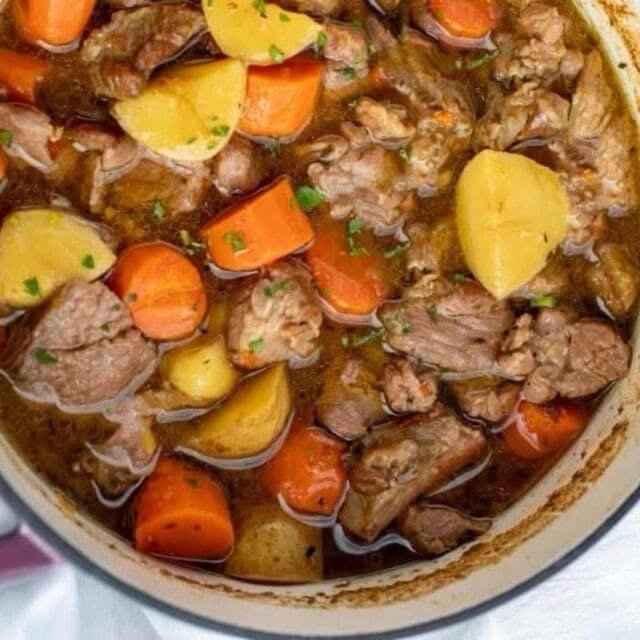
There is no dish that says “comfort” quite like a pot of lamb stew simmering on the stove. The aroma alone—earthy rosemary, sweet garlic, tender chunks of lamb, and deep, savory broth—can transform a chilly evening into something special. This lamb stew recipe delivers all of that and more: fall-apart tender meat, hearty vegetables, and a rich, velvety sauce that begs to be sopped up with crusty bread.
Lamb stew is a classic across many cultures, from Irish and British to Greek and Moroccan. This version takes the best of those traditions—slow-cooked lamb shoulder or stew meat, aromatic vegetables, red wine, and fresh herbs—and simplifies the process for the home cook. You do not need a Dutch oven or hours of active time. Just a bit of patience as the stew bubbles away on the stovetop or in the oven, transforming humble ingredients into something extraordinary.
What makes this lamb stew so special is the lamb itself. Unlike beef, lamb has a distinct, slightly sweet, and grassy flavor that pairs beautifully with root vegetables and herbs. When cooked low and slow, the connective tissue breaks down, creating meat so tender it falls apart at the touch of a fork. This is the kind of meal you make on a Sunday afternoon, let fill your kitchen with its fragrance, and serve to grateful family and friends.
Why You Will Love This Lamb Stew
· Incredibly tender lamb: Slow cooking transforms tough cuts into melt-in-your-mouth perfection.
· Rich, deeply flavorful broth: Red wine, tomato paste, and fresh herbs create layers of flavor.
· One-pot meal: Everything cooks together in a single Dutch oven or heavy pot.
· Make-ahead friendly: Tastes even better the next day.
· Freezer-friendly: Double the batch and save half for a busy night.
· Impressive but approachable: Simple techniques yield restaurant-quality results.
· Customizable: Swap vegetables, adjust herbs, or add your favorite spices.
Ingredients
Here is everything you need for the perfect lamb stew:
For the Lamb:
· 3 pounds lamb shoulder or lamb stew meat, cut into 1½-inch cubes
· 1 teaspoon salt
· ½ teaspoon black pepper
· 3 tablespoons olive oil or vegetable oil, divided
For the Aromatics and Vegetables:
· 1 large yellow onion, diced
· 3 carrots, peeled and cut into 1-inch chunks
· 2 celery stalks, sliced into ½-inch pieces
· 4 cloves garlic, minced
· 2 tablespoons tomato paste
· 1 cup dry red wine (such as Merlot, Cabernet, or Pinot Noir)
· 4 cups beef broth or lamb broth (low-sodium recommended)
· 1 can (14.5 ounces) diced tomatoes, undrained
· 2 bay leaves
· 3 sprigs fresh rosemary (or 1 tablespoon dried)
· 4 sprigs fresh thyme (or 1 tablespoon dried)
· 1 pound Yukon Gold or baby potatoes, halved or quartered (leave skins on)
· 1 cup frozen peas (optional, add at the end)
For Thickening (Optional):
· 2 tablespoons cornstarch mixed with 2 tablespoons cold water (slurry)
For Serving (Optional):
· Fresh parsley, chopped
· Crusty bread or dinner rolls
· Mashed potatoes or creamy polenta
Step-by-Step Instructions
Step 1: Prepare the Lamb
Pat the lamb cubes completely dry with paper towels. This is essential for good browning. Season generously with salt and pepper.
Step 2: Brown the Lamb
Heat a large Dutch oven or heavy-bottomed pot over medium-high heat. Add 2 tablespoons of olive oil. When the oil is shimmering, add the lamb in a single layer. Do not overcrowd—work in batches if necessary. Sear for 3 to 4 minutes per side until deeply browned on all sides. Use a slotted spoon to transfer the browned lamb to a plate and set aside.
Step 3: Sauté the Vegetables
Reduce the heat to medium. Add the remaining 1 tablespoon of olive oil to the pot. Add the diced onion, carrots, and celery. Cook for 5 to 7 minutes, stirring occasionally, until the vegetables have softened and the onion is translucent. Add the minced garlic and cook for 30 seconds until fragrant.
Step 4: Add Tomato Paste
Add the tomato paste to the pot. Cook for 1 to 2 minutes, stirring constantly, until the tomato paste darkens slightly and becomes fragrant. This step deepens the flavor.
Step 5: Deglaze with Wine
Pour the red wine into the pot. Use a wooden spoon to scrape up all the browned bits from the bottom of the pot. Bring the wine to a simmer and let it reduce by about half, approximately 3 to 4 minutes.
Step 6: Add Broth, Tomatoes, and Herbs
Return the browned lamb to the pot. Add the beef broth, diced tomatoes with their juices, bay leaves, rosemary sprigs, and thyme sprigs. Stir to combine. Bring the stew to a gentle boil, then reduce the heat to low.
Step 7: Simmer the Stew
Cover the pot with a lid and simmer gently for 1 hour and 15 minutes. Stir occasionally to prevent sticking.
Step 8: Add the Potatoes
After 1 hour and 15 minutes, add the halved or quartered potatoes to the pot. Stir to incorporate. Cover and continue simmering for another 30 to 45 minutes, until the lamb is fork-tender and the potatoes are soft.
Step 9: Thicken the Stew (Optional)
If you prefer a thicker stew, remove the lid and let it simmer uncovered for 10 to 15 minutes to reduce the liquid. Alternatively, stir in the cornstarch slurry and cook for 2 to 3 minutes until the sauce thickens.
Step 10: Add Peas and Finish
If using frozen peas, stir them in during the last 5 minutes of cooking. Remove the bay leaves and woody herb stems. Taste the stew and adjust seasoning with additional salt and pepper if needed.
Step 11: Rest and Serve
Let the lamb stew rest off the heat for 10 minutes. Garnish with fresh parsley. Serve hot, with crusty bread or over mashed potatoes.
Cooking Tips and Pro Tips for Best Results
· Use the right cut of lamb: Lamb shoulder is ideal for stewing. It has enough marbling and connective tissue to become tender and flavorful after long cooking. Avoid lean cuts like loin or leg—they will become dry and tough.
· Brown the lamb properly: Do not rush this step. Deep browning creates the fond (browned bits) that forms the flavor base of the stew. Work in batches to avoid overcrowding.
· Pat the lamb dry: Moisture prevents browning. Use paper towels to blot the lamb cubes before seasoning.
· Use good quality broth: The broth is a major flavor component. Low-sodium beef or lamb broth allows you to control the salt level. Avoid bouillon cubes if possible.
· Do not skip the wine: Red wine adds acidity, depth, and complexity. If you prefer not to use alcohol, substitute with an equal amount of beef broth plus 1 tablespoon of red wine vinegar or balsamic vinegar.
· Simmer gently, do not boil: Boiling can make the lamb tough and the vegetables mushy. A gentle simmer with small bubbles is perfect.
· Make it ahead: Lamb stew tastes even better the next day as the flavors meld. Make it a day ahead, cool, refrigerate, and reheat gently before serving.
Variations and Substitutions
· Irish lamb stew: Omit the wine and diced tomatoes. Add 1 cup of stout beer (like Guinness) and 2 cups of beef broth. Use pearl onions instead of diced onion. Add turnips or parsnips.
· Greek lamb stew (Kokkinisto): Add 1 cinnamon stick, 2 whole cloves, and 1 teaspoon of dried oregano. Serve over orzo or with crusty bread. Omit the potatoes and peas.
· Moroccan lamb stew: Replace the wine with 1 cup of water. Add 1 teaspoon each of ground cumin, ground coriander, and ground ginger. Add ½ teaspoon of cinnamon and a pinch of saffron (optional). Stir in ½ cup of dried apricots and ¼ cup of raisins. Serve over couscous.
· Lamb and lentil stew: Add 1 cup of dried brown or green lentils when you add the broth. Increase the broth to 5 cups. Omit the potatoes.
· Low-carb lamb stew: Omit the potatoes. Add extra cauliflower florets or turnips in their place. Serve over cauliflower rice.
· Slow cooker lamb stew: Brown the lamb and sauté the vegetables as directed. Transfer everything to a slow cooker. Add the remaining ingredients (except peas). Cook on LOW for 7 to 8 hours or on HIGH for 4 to 5 hours. Stir in peas during the last 15 minutes.
· Instant Pot lamb stew: Use the sauté function to brown the lamb and vegetables. Add remaining ingredients (except peas). Pressure cook on HIGH for 35 minutes, then natural release for 15 minutes. Stir in peas.
Serving Suggestions
This lamb stew is a complete meal on its own, but it pairs beautifully with:
· Crusty bread or dinner rolls: Essential for sopping up every drop of the rich broth.
· Mashed potatoes: Serve the stew over a bed of creamy mashed potatoes.
· Creamy polenta: The soft, buttery polenta is a wonderful match.
· Buttered egg noodles: Wide noodles catch the chunks of lamb and vegetables.
· Simple green salad: A bright, lemony salad cuts through the richness.
· Roasted vegetables: Extra roasted carrots or parsnips on the side.
For beverages, a glass of the same red wine you used in the stew, a hearty ale, or a warm cup of tea are all excellent choices.
Storage and Reheating Instructions
Refrigerator Storage
Store leftover lamb stew in an airtight container in the refrigerator for up to 4 days. The flavors continue to develop, making leftovers even more delicious.
Freezer Storage
Lamb stew freezes beautifully for up to 3 months. Cool completely, then transfer to freezer-safe containers or heavy-duty bags. Leave some headspace for expansion. Thaw overnight in the refrigerator before reheating.
Reheating Instructions
· Stovetop method (best): Reheat in a saucepan over medium-low heat, stirring occasionally, until warmed through. Add a splash of broth or water if the stew has thickened too much.
· Microwave method: Heat individual portions in a microwave-safe bowl for 2 to 3 minutes, stirring halfway through.
· Oven method: Transfer to an oven-safe dish, cover with foil, and heat at 325 degrees Fahrenheit for 20 to 25 minutes.
Do not reheat more than once. Only reheat the portion you plan to eat.
Nutritional Information
Approximate per serving (based on 6 servings, without bread or optional sides):
· Calories: 520
· Protein: 35g
· Fat: 28g
· Saturated Fat: 10g
· Carbohydrates: 28g
· Fiber: 5g
· Sugar: 8g
· Sodium: 680mg
· Vitamin A: 90% DV
· Vitamin C: 25% DV
· Iron: 25% DV
· Calcium: 8% DV
Note: Nutritional values are estimates and will vary based on specific ingredients, portion sizes, and fat content of lamb.
Frequently Asked Questions
What is the best cut of lamb for stew?
Lamb shoulder is the best cut for stew. It has the perfect balance of fat, collagen, and meat. As it cooks low and slow, the collagen breaks down into gelatin, making the meat incredibly tender and the broth rich. Lamb neck, shank, or stew meat (often a mix of shoulder and trimmings) also work well. Avoid lamb leg or loin—they are too lean and will become dry and tough.
Can I make lamb stew without wine?
Yes. Substitute the red wine with an equal amount of beef broth plus 1 tablespoon of red wine vinegar or balsamic vinegar. The vinegar provides the acidity that balances the richness of the lamb. You can also use 1 cup of grape juice mixed with 1 tablespoon of vinegar for a non-alcoholic alternative.
How do I know when the lamb is tender enough?
The lamb is ready when it falls apart easily with a fork. Depending on the size of your cubes and the heat level, this can take 1½ to 2½ hours of simmering. Taste a piece—it should be buttery and almost melt in your mouth, not chewy or stringy.
Why is my lamb stew greasy?
Lamb can be fatty, especially shoulder cuts. To reduce greasiness, trim visible fat from the meat before cutting into cubes. After browning, you can pour off excess fat from the pot before adding the vegetables. You can also refrigerate the finished stew overnight—the fat will solidify on the surface and can be easily removed before reheating.
Can I use frozen lamb for this recipe?
Yes. Thaw frozen lamb completely in the refrigerator before cutting and browning. Do not cook from frozen, as the meat will not brown properly and may cook unevenly.
What herbs go best with lamb stew?
Classic pairings include rosemary, thyme, bay leaves, and parsley. Oregano, marjoram, and sage also work well. For a Mediterranean twist, add mint. For a North African flavor, use cumin, coriander, cinnamon, and saffron.
Can I add other vegetables to this stew?
Absolutely. Parsnips, turnips, celery root, rutabaga, and sweet potatoes are all excellent additions. Add them along with the potatoes. Mushrooms, leeks, and pearl onions also work well. Avoid vegetables that break down too quickly, like zucchini or summer squash—add those in the last 15 minutes.
Why do I need to brown the meat in batches?
Overcrowding the pot lowers the temperature and causes the meat to steam instead of sear. Steaming prevents the development of the deep brown crust that creates flavor. Brown in batches, giving each piece space to make direct contact with the hot surface.
Final Thoughts
Lamb stew is the ultimate comfort food—a dish that rewards patience with incredible depth of flavor and tender, fall-apart meat. It is the kind of meal that turns a simple Sunday into something special, filling your kitchen with an aroma that promises warmth and satisfaction.
This recipe honors the tradition of slow-cooked stews while remaining approachable for home cooks. Brown the meat, sauté the vegetables, deglaze with wine, and let time and gentle heat do the rest. The result is a stew that is rich, hearty, and deeply flavorful—one that will have everyone asking for seconds.
So find a good cut of lamb shoulder, a bottle of red wine, and a few hours. Let this stew simmer on your stove, and prepare to fall in love with the most comforting dish of the season. Serve it with crusty bread, a glass of the same wine, and the people you love. That is what lamb stew is all about.